
As the country readies to go to polls on July 25, one can't deny the role of the military, but there are other factors too.
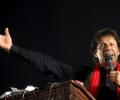
The Pakistani election on July 25 has a strong Indian flavour and connection, says Vivek Shukla.
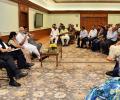
'While Piyush Goel, Dharmendra Pradhan, Rajyavardhan Singh Rathore and a clutch of former bureaucrats including R K Singh, Hardeep Singh Puri and K J Alphons are loyal BJP members, none of them fit the mould of party apparatchiks.' 'In fact, many of the latter kind have been shown the door or have been given reduced charges.' 'That goes to show the prime minister's comfort level in dealing with professionals and administrators and the trust he reposes in them,' says Shreekant Sambrani.
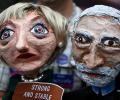
The United Kingdom votes on June 8. A quick guide to the post terror election.
'The India-Pakistan relationship is in a deep freeze, though it could be a lot worse had there not been a new LoC ceasefire a year ago.' 'The India-Pakistan relationship will only start to thaw if the Pakistani military decides it's prepared to push for detente.'

'Some of his decisions were not so good, but his intentions were always guided by a deep national interest.'

Pakistan's embattled former military dictator Pervez Musharraf has refused to leave the country on "medical grounds" until he is given "clean chit" in high treason and other cases, according to a close aide.

For all the controversy, the concept of prominent First Children is not novel in democracies. So why is Donald Trump's daughter different and discomfiting?
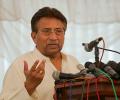
Former Pakistani dictator Pervez Musharraf has sought "forgiveness" for any wrongs he may have committed during his nine-year regime, saying he will face all cases against him and not flee the country like a coward.
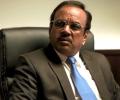
'If one is saying the Modi government makes me feel insecure or will put me in jail if I say anything against him, do not worry, as he won't do any such thing.'

The plan hinged on two critical assumptions: India would not be able to replenish supplies quickly to launch a counter-attack. India could not respond in enough strength to dislodge the Pakistanis. Both assumptions would be proved wrong due to the ferocity of the Indian response, reveals former RAW officer Tilak Devasher in his new book, Pakistan At The Helm.

Protesting against enforced disappearances in Balochistan, Abdul Qadeer Baloch, 72, has led a small group that has covered more than 2,000 kilometres on foot, breaking the 84-year-old record set by Mahatma Gandhi during his Dandi march. Hamid Mir reports from Islamabad.

'She was the only prime minister who won a decisive military victory.' 'She won a real war; she didn't play video games on prime time TV over surgical strikes!' 'She understood power better than any other politician, saw it as her birthright and used it with inborn expertise.' 'Every politician today who tries to be a "supremo" through populism and absolute control over his or her party is referring to the Indira Gandhi playbook!'

Counting has begun for the election which will be the second democratic transition of power in the nation's 70-year history.

Experts trace the reasons for the 26/11 attacks to the Pakistan's military interest in three key areas: Kashmir, Afghanistan and nuclear armaments.

What happened in Uttarakhand is a national tragedy. Why couldn't Dr Manmohan Singh announce that he was forming an Uttarakhand Relief and Rehabilitation Committee, with himself as chairman but inviting Narendra Modi to become the deputy chairman, asks T V R Shenoy.

Kanti Bhatt, respected Gujarati author and journalist, passed into the ages on August 4, 2019, at the age of 88. In tribute, we reproduce an article his wife Sheela Bhatt wrote about him 19 years ago.

'The only quality required in this tenure is to be the military's yes man and that he has the capacity to do so.'
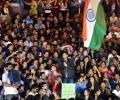
Shekhar Gupta has a question for Kanhaiya Kumar, but a bigger, more vital, one for the honourable judge.
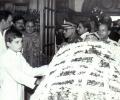
'They were the leaders of my country and the children of Mother India, but they didn't die as martyrs.' 'They were killed, most unfortunately, by a well planned enemy plot, and they were victims of political violence,' states Sudhir Bisht.

During a war, there are just four possibilities a soldier faces. One: Victorious and safe. Two: Wounded. Three: Killed in action. Four: Prisoner of War. It was my fate to face the fourth, says Colonel Anil A Athale (retd) on the year spent as a prisoner of war in Pakistan during the 1971 War.
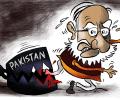
For the first time in our political history, Pakistan has become centre stage of the incumbent's campaign, points out Shekhar Gupta.
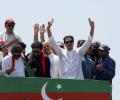
There has always been a risk-taking edge to Imran Khan. Like him or hate him, it had to be someone like him to finally threaten to demolish the Pakistani establishment, explains Shekhar Gupta.
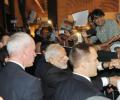
'You can see the essential contours of his new Pakistan strategy. Rather than keep engaging with or humouring them, he'd rather work on taking their four biggest supporters -- the US, China, the UAE and later Saudi Arabia -- away from them.' 'In his calculation,' says Shekhar Gupta, 'with the total support of all four of these, Pakistan will be forced to moderate its policies.'
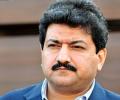
'I want to be murdered at your hands, so I can live on in history. The verdict of who is or is not a traitor cannot be pronounced by a secret agency, but by history.' Pakistani journalist Hamid Mir, who survived an assassination attempt on April 19, challenges his enemies to dub him a traitor and says nothing will stop him from exposing them.

If things work out, it will be a great leap forward in the Indian-Iranian economic ties in the new phase of Iran's reintegration with the world market following the lifting of sanctions, says Ambassador M K Bhadrakumar.

The year is coming to an end and overall, it's been one hell of a year! We have had our share of ups and downs and we look forward to a better 2020. While we count down the days to the new year, let's also reflect on those who gave us strength to stand up in what we believe, the courageous who didn't bow down and the ones with gumption who inspired us to be better. We, Rediff.com, have selected 26 personalities, who we think are worthy of the title -- HERO OF THE YEAR -- and we want you, dear readers, to choose your hero!

Hein Kiessling has the kind of access in Pakistan that journalists (and spies) would die for, says Kanika Datta.

'Islamabad is only as big as a Delhi suburb.' 'How can a city with just two five star hotels and only one departure gate at their international airport be compared to Delhi with its sprawling airport?' Ambassador T P Sreenivasan finds the pulse of Pakistan after visiting Islamabad for the first time.

'If you take pride only in being a nation with nuclear weapons and a strong military, then you think very differently from those nations that take pride in having wonderful universities and academic institutions.'
'Even if we expect that the economy will be hit and GDP is lowered for a few quarters by the reckless demonetisation, this will itself not be sufficient to dislodge Modi's popularity,' says Aakar Patel.

Given our troubled relationship with Pakistan, we need to keep our security apparatus in a state of alert with state-of-the-art equipment. All bilateral issues with Pakistan -- political, military, economic -- will simply have to go on the back-burner till Pakistan decides it wants to live as a good neighbour, says Vikram Sood.

'Pakistan needs to be constantly at war with somebody, ultimately resulting in it waging war on itself and its own people,' says Shekhar Gupta.
 © 2026 Rediff.com - Advertise with us - Disclaimer - Privacy Policy - Sitemap - Feedback - About us - Terms of use - Grievances